GENKI LAB
HomeNewsResearchToolsLabTeamGuidelinesHelp
GenKI Lab
Sign in
de

Generative AI
for the University of the Arts

The GenKI Lab at UdK Berlin.

News

News

Between trial, research and discourse: current work from teaching and research, joint projects and formats for exchange.

← Back to News
5 November 2026

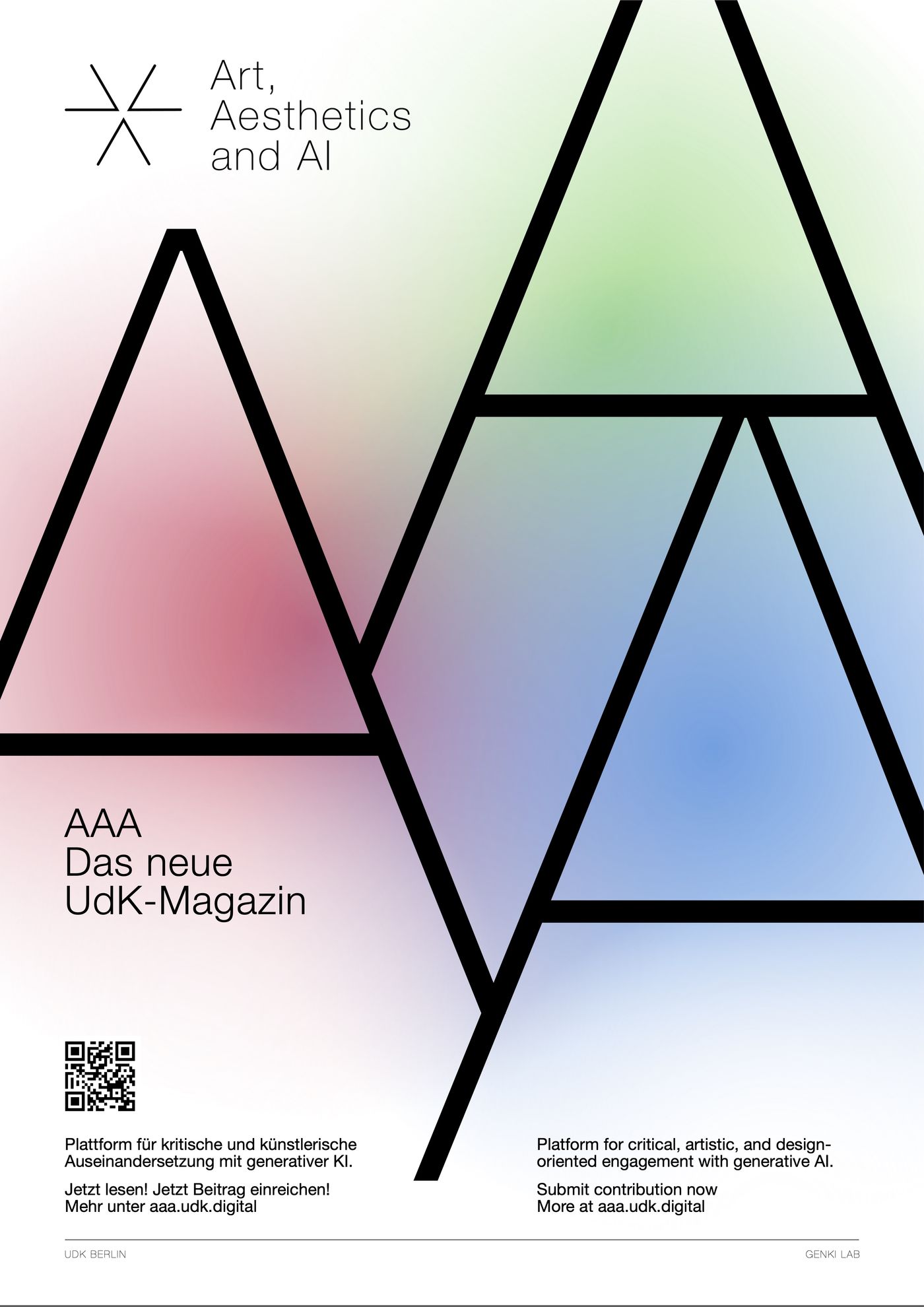
Art, Aesthetics and AI Magazine

UdK's new magazine, taking a critical look at the interplay of artificial intelligence, aesthetics and art.

After the first issue of the magazine launched successfully at Rundgang 2026, there is a new open call for the upcoming second issue, for exciting contributions on the relationship between AI, art and aesthetics.

The first issue of AAA, plus everything about the editorial team and the open call!

03 Nov 2026

UdK AI Day

UdK's annual AI Day takes place again on 6 November 2026. From 1 pm to 5 pm, there will be talks on current AI projects at UdK in the auditorium of the Medienhaus.

03 Nov 2026

Groß-Pinnow – An experiment with nine AI agents

Groß-Pinnow is a narrative-theory experiment with nine AI agents who meet in a virtual setting and develop a story together.

15 Oct 2025

Alice Weidel's Guilty Conscience

The project is an experimental AI agent that responds to tweets by AfD politician Alice Weidel with satirical, revealing counter-narratives – written from the point of view of her guilty conscience. The aim is an intervention in digital space that pushes back against the far-right politician.

Research

Research

Three questions drive us: What does generative AI do to artistic work? How do we teach with AI, rather than only about it? How do we remain co-authors in automated systems?

Experimental research in artistic contexts

How can generative models help create new visual and conceptual works? We test current AI media technology in an artistic context: as a tool, as material, as a counterpart. And we say where it holds up and where it does not.

GenAI in exploratory teaching formats

How do we teach and learn with AI, rather than only about AI? We design scenarios for artistic teaching and test what changes in the seminar, the studio and the exam when AI is in the room.

World models as an interface

Who is actually telling the story when systems model reality? From narration and narrative theory to identity construction in automated communication systems: a critical analysis of world models as the interface between data and social reality.

Learning and discourse architectures

How does knowledge change when the other side of the dialogue is a machine? We study teaching formats as discourse architectures: how human–AI dialogues rearrange orders of knowledge, authority and relationships. The focus is on relational knowledge between humans and GenAI.

Tools

Tools

Text, image or speech AI, through a web interface or through an API: these services are currently available to use on UdK servers.

Exclusively for UdK students, teaching staff and employees: please sign in with your UdK login.

Sign in with your UdK login, create an access key (API key), enter it in your tool.

Images from text prompts, made on the lab's GPUs.

Transcribe speech: recordings and audio files as text, with Whisper on UdK computers.

Have texts read aloud, also in a reference voice of your own. With Chatterbox on UdK computers.

Chat, writing, code, agents. The sovereign models run on UdK computers.

Lab

Lab

Not a data centre, but a lab for the arts of tomorrow: the GenKI Lab at the Berlin University of the Arts works at the intersection of generative artificial intelligence and innovative artistic teaching in higher education. We offer a flexible, modular AI infrastructure and access to state-of-the-art GenAI technologies.

The research and development of future-oriented use cases goes hand in hand with the critical analysis of risks. We curate the current technological landscape to inspire teaching staff and students alike to new forms of creative expression and teaching formats.

8
Team members
2
Universities in the vCoP

Leading by example

We test use cases in advance so you don't have to start from scratch. Instead of one-to-one advice in an emergency, our approach aims at orientation, inspiration and room for happy accidents.

More than a toolbox

We build our own solutions. What proves itself, we try to scale up into a service for all of UdK.

Part of the artistic and research community

We plan events, run workshops and take part in course formats at UdK and partner universities, as well as in research projects.

Team

Team

Artists, researchers, technologists and educators.

Heads the GenKI Lab at UdK Berlin and is responsible for the lab's strategic direction within the MIDAP consortium. The focus is not just on accompanying the transformation brought by generative AI at an art university, but on actively shaping it — as a place for experimentation, critical thinking and creative appropriation.

Leads the experimental exploration of current AI media technology: what uses and potential do generative methods offer MIDAP projects? Researches and evaluates new developments, tests them in an artistic context and makes them usable for project work.

Develops experimental teaching formats in MIDAP as discourse architectures for new forms of human–AI dialogue. Studies how interventions reconfigure orders of knowledge, authority and relational learning processes.

Develops strategic, design-led AI teaching formats for GWK and UdK. Focuses on narrative theory, identity construction in automated communication systems and the critical analysis of world models as the interface between data and social reality.

Builds and runs the lab's technical platform: from the GPU servers in UdK's own data centre and the central AI access to the services that students, teaching staff and administration work with. The focus is sovereign, locally run AI: open models on our own hardware, privacy-compliant and built for an art university.

Researches and tests how effective agentic systems are for research and academic work. How does the potential of artificial intelligence affect how teaching is planned and delivered at an art university? How should universities respond to this change?

Works on the relationship between humans and artificial intelligence, especially questions of empathy and emotional belonging. Automated agentic systems for research and organisation, and local models, are a further focus.

AI as a tool for new creative possibilities and the democratisation of design. Also works on the social and ethical questions and implications of artificial intelligence.

Guidelines

Guidelines

Using AI in study, teaching and exams needs clear rules that keep pace with the technology. The UdK Berlin AI guideline applies in its current version.

The key rules in brief

  • AI may take work off your hands, but not the thinking.
  • Choose the model that fits the task.
  • The model is happy to agree with you. That is a risk, not a compliment.
  • Respect privacy and copyright: whose face, voice or work is in the input? (This also applies to teaching staff assessing students' work.)
  • For maximum protection of your data: we do not record or store what users ask or what the model answers.

Our Vision for Teaching in the Age of GenAI – A Manifesto

Teaching must convey the technological foundations of GenAI, respond to what each student already knows, and presupposes teachers who are informed in the field. These elements are necessary for any practical use – such as artistic, experimental work and critical reflection – whether or not GenAI is used in the end. This includes knowing how the technology works, and also its social and ecological costs. GenAI literacy does not require using the tools: students and teachers should be free to choose whether they use GenAI or not.

Teaching must convey a differentiated skill set for dealing with GenAI. This includes the students’ ability to critically assess results on an aesthetic, content-related and ethical-social level. To acquire this ability, a direct and repeated engagement with the “material” must be ensured, provided in teaching and placed before the use of GenAI.

What we mean by engagement here is an educational process led and shaped substantially by, with and for people.

Teaching must recognise that GenAI is no longer a classic tool, but that we stand in a complex – dialogic as well as practical – “co-productive” relationship with it. It is precisely this relationship that must be defined, reflected on and worked out by and in teaching.

GenAI tools can be trusted only to a limited extent. It follows that a critical stance must come before their use (see § 1). Being critical does not automatically mean refusing to use them altogether.

Teaching in artistic contexts requires different – practical as well as reflective – approaches to GenAI than in academic contexts. The specifics of each discipline must be taken into account in an ongoing, critical process. Individual disciplines must be able to develop their own approaches on their own responsibility.

Teaching must not ignore the legal questions of data protection in the use of GenAI and must address them proactively. This applies in particular while there are still no guidelines binding on all disciplines. A university must take a clear position here – for instance on possible violations of personality rights or copyright. The use of locally installed open-source models should be prioritised to ensure safe use that complies with data protection.

Teaching must take account of emerging professional forms of practice against the background of a changing educational horizon. That new practices emerge using GenAI also means that classic forms of practice gain relevance (see § 1).

Teaching must focus on conveying processes of appropriation – processes become more relevant than results. Experimenting, playing and “tinkering” become central basic skills in a time of rapid technological innovation. Basic knowledge in the age of GenAI calls for a broad meta-expertise that can be applied across the most varied disciplines.

Teaching itself cannot, in its essence, be replaced or automated by GenAI. Presence, interpersonal communication and physical presence remain core parts of the teaching of the future.

Help

Help

Questions? Problems? Here you will find step-by-step guides to our services.

Guides
help.udk.digital
Imprint

Imprint

udk.digital is a service of the Berlin University of the Arts. The UdK Berlin imprint applies.

UdK Berlin imprint
udk-berlin.de/en/imprint